The Fateful Day: April 26th, 1889
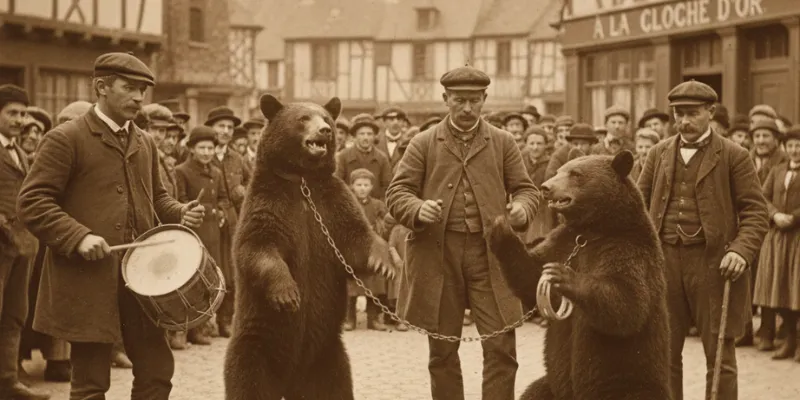
In the twilight of the 19th century, when the pits and quarries of the Forest of Dean were buzzing with colliers and labourers, four French itinerants arrived. Their names were Gabriel Yas, Gabriel Huguet, Thomas Sirgent, and Alfred Gerard, and they brought with them two Russian black bears - performing animals, chained and led, intended to entertain the hard- working locals.
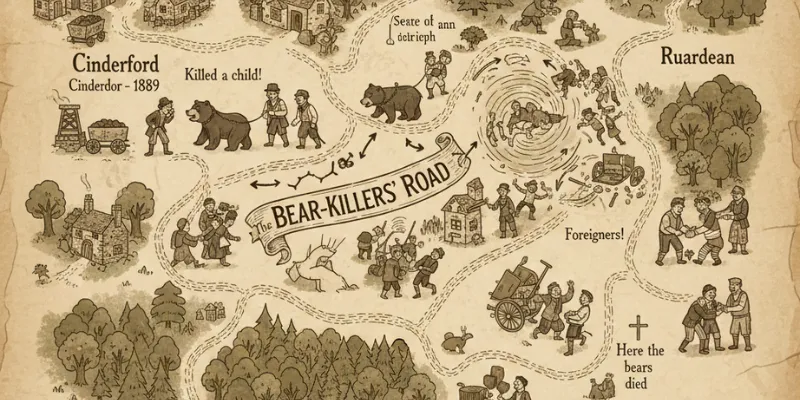
They had finished their performance in the bustling mining town of Cinderford and were making their way, with their lumbering, tame beasts, toward the village of Ruardean. A crowd of curious children and youths followed their unusual procession.
🔥 The Spark of Calumny
As they walked the dusty road between the settlements, a malicious rumour was whispered, then shouted, then seized upon like wildfire: the bears had killed a child and mauled a woman! In those days, a lingering, ignorant fear persisted that foreign bear-keepers fed their animals on the flesh of local children.
This calumny, utterly baseless though it was, ignited the volatile spirit of the Foresters. An angry mob, swelled by colliers pouring out of the local pubs near Nailbridge, began to pursue the Frenchmen and their bears. The mob soon grew to a terrifying size - some say over 200 strong - armed with sticks, stones, and iron bars.
🩸 The Brutal Attack
The terrified Frenchmen were surrounded, savagely beaten, and rolled in the mud. The innocent bears, unable to defend themselves or their owners, were attacked with unrelenting ferocity. One bear was slaughtered in the road. The second, freed by its desperate keeper to run for its life, was chased into the woods and ultimately shot by the mob.
As the violence peaked, residents of Ruardean witnessed the brutal spectacle. Unlike the attackers, these locals rushed to the scene not to join the melee, but to shelter and nurse the battered and bleeding Frenchmen, saving them from further harm.
Historical Context
Dancing bears were a common sight in 19th-century Britain, brought by travelling showmen from Eastern Europe. These shows were popular entertainment in rural areas, though the treatment of the animals was often cruel by modern standards.
- Bears were trained through harsh methods
- Shows travelled village to village
- Escapes were not uncommon
- Public fear often led to violent responses
The bears were not monsters—just tired, chained creatures far from home. But fear has a way of making monsters out of shadows.
⚖️ The Unjust Echo
The attackers, mostly colliers and labourers from Cinderford, were eventually brought before the magistrates at Littledean Police Court. They were convicted and heavily fined for ill-treating and maliciously killing the bears, and for the assault on the Frenchmen.
Yet, a cruel twist of fate solidified the ensuing bitterness: in the official court reports, the guilty men were mistakenly or deliberately described as "colliers and labourers of Ruardean."
This inaccuracy, whether by error or design, cast a shadow of shame upon the village of Ruardean, wrongly implicating the very people who had provided sanctuary.
🗣️ The Taunt
To this day, the shameful question—"Who killed the bears?"—has survived as a taunt, a divisive phrase passed down through generations, fueling a long-running, painful rivalry between the people of Cinderford and Ruardean, marking the spot where two innocent creatures died for a lie.
The shouting drowned out the keepers' protests. In the crush of fear and bravado, the decision was made without ever truly being spoken. Sticks became clubs. Voices became a roar.
By morning, the bears lay still, and the forest carried a silence heavier than any verdict.
Story Resources
NoThe synopsis I provided is based on a well-established local historical incident, and its sources can be broken down into: 1. 📰 Contemporary Newspaper Reports (Primary Sources) The most factual and immediate sources are the reports from the period of the event and the ensuing trial. Date of Incident: April 26th, 1889. The Trial: Court proceedings took place at Littledean Police Court in the week following the incident (around May 3rd, 1889). Local Press: Reports were carried by local papers, most notably the Dean Forest Mercury and the Gloucestershire Echo. These papers documented the charges, the names of some of the Frenchmen (Gabriel Yas, Gabriel Huguet, Thomas Sirgent, and Alfred Gerard) and the convicted colliers/labourers, and the heavy fines imposed for killing the bears and assault. National Press: The event was widely reported in the national press (e.g., the Cheltenham Chronicle), which often sensationalized the incident and used it to portray the Foresters as "savages" (a key part of the rivalry's legacy). 2. 📚 Later Historical & Literary Accounts These sources help analyze the facts, the resulting feud, and the cultural impact. "Who Killed The Bears?" by Leonard Clark (1964): This book by a Forest poet is often cited as the primary modern text that collected and recounted the known historical facts of the event, helping to cement the story's place in Forest lore. Court Records/Police Offence Books: Details regarding the charges, fines, and the places of residence of the accused men (which is the source of the Cinderford vs. Ruardean dispute) are found in the official court records, often summarized in local history archives (like the Littledean Jail or Dean Heritage Centre). The discrepancy over whether the accused were mostly from Cinderford or Ruardean is a key historical debate. "A Beast With Two Backs" by Dennis Potter (1968): The famous television play by the Forest-born writer, while a fictionalized account, drew directly on the incident and its themes of xenophobia, mob violence, and false accusation. In summary, the core facts (date, names, location, incident, trial, fines) are historically verified through 1889 court records and contemporary newspaper reports. The lasting cultural impact and the Cinderford/Ruardean feud are documented in subsequent local histories and literary works.
🏛️ The Trial and Convictions The local authorities made arrests swiftly, and a large group of men was brought before the magistrates at Littledean Police Court just a week after the incident, around May 3rd, 1889. Total Prosecuted: Sources vary slightly, but around 13 to 14 colliers and labourers were formally charged. Convictions: All but two of the accused men were convicted of one or more charges. The Charges: The men were charged with: Ill-treating, torturing, and maliciously killing the bears. Assaulting the Frenchmen (Gabriel Yas, Gabriel Huguet, etc.). 💰 The Punishment The punishment was significant for the time, reflecting the seriousness of the mob violence: Fines: The convicted men were heavily fined. The total sum paid in fines and damages was reported to be around £85 (which is equivalent to several thousands of pounds in today's money). This was a massive financial blow for working colliers and labourers. Imprisonment: Some of the men faced the alternative of one month's imprisonment if they could not pay the fines. Compensation: A public subscription was also launched to generously compensate the French bear-keepers for the loss of their animals and their injuries. ❓ The Source of the Feud The enduring bitterness comes from a critical detail in the trial's reporting: The men convicted were largely from the Cinderford area, including the ringleader, George Wilkes, the landlord of the Jovial Colliers pub in Nailbridge. However, reports from the court, whether by error or malicious intent, mistakenly or deliberately described the guilty men as "colliers and labourers of Ruardean." This inaccuracy wrongly placed the shame of the mob violence upon the village of Ruardean—whose residents had actually tried to help the Frenchmen—creating the infamous taunt, "Who killed the bears?"
First it was whispered in corners. Then it turned into a jeer. Then into a chant. At football matches, in pub doorways, across market squares, the question was hurled like a stone.
The incident occurs; initial blame and confusion
The phrase becomes a common taunt between villages
Used regularly at sporting events and local rivalries
Still remembered by older generations; fading from use
A Question That Wounds
Years passed, and the bears turned from memory into myth, from shame into ammunition. At the edge of a match pitch or beside a bar counter, someone would call across:
Laughter followed, or sometimes fists. The question was never really meant to be answered. It was meant to wound, to remind, to divide.
Children grew up hearing it without understanding it. Adults used it without thinking. It became part of the landscape, like the trees and the coal dust—just another thing that was always there.
What the Forest Remembers
Decades later, a child from Ruardean stood in the schoolyard, cheeks burning, as the familiar shout went up from the Cinderford lads:
"Who killed the bears?"
He didn't know exactly what had happened back then, only that it was supposed to be his village's shame. That evening, he asked his grandfather.
The old man sighed, stared towards the dark line of trees, and said,
In the end, the bears were long gone, but the question remained, passed down like a family heirloom nobody really wanted.
Perhaps it was a handful of men on a single night. Perhaps it was a whole forest that chose fear over compassion. Or perhaps, over the years, the story itself did the killing—turning living creatures into a punchline and neighbours into enemies.
The forest remembers more than it says. The rest is told in the way people still flinch, just a little, when the old taunt is thrown across the valley.
Questions for Reflection
- What might the villagers have done differently when they heard about the bears?
- Why do communities turn painful events into jokes or insults?
- How does fear change the way people see the world around them?
- What responsibility do we have for stories passed down to us?
- Can a community heal from old wounds, or do some stories never truly end?